Motorcycle Exhaust systems do much more than route gases away from the engine. They influence backpressure, heat management, packaging space, sound tuning, installation complexity, and how easily the system can be adapted across different bike platforms. For buyers sourcing for distribution, brand programs, or multi-model fitment projects, knowing the two primary exhaust types helps you specify the right structure, interface points, and customization scope from the start.
In the industry, motorcycle exhaust upgrades and replacement programs are most commonly divided into two types: Slip-On Exhaust and Full System Exhaust. Below is a sourcing-oriented explanation designed for professional buyers, distributors, and solution providers.
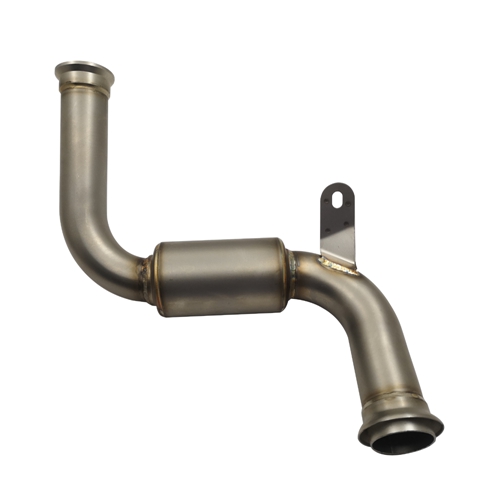
A Slip-On Exhaust replaces only the muffler section and, in some designs, a short mid or link pipe, while keeping the original header pipes unchanged. Because the engine-side geometry remains OEM, this type focuses on sound tuning, visual upgrade, and weight optimization without altering the full exhaust routing.
From a commercial sourcing perspective, slip-on exhausts are widely adopted because they simplify fitment control across multiple models. Installation complexity is low, and the risk of incompatibility is reduced, which is especially important for large-volume distribution programs.
For manufacturers and buyers, the key engineering considerations include inlet diameter accuracy, clamp or joint structure, hanger alignment, and clearance to surrounding components. When these points are controlled, slip-on systems can achieve high compatibility with minimal variation.
At RUIYUE, slip-on motorcycle exhaust development emphasizes scalable structures, allowing shared muffler bodies combined with model-specific link pipes. This approach supports customization while keeping production efficient for bulk order programs.
A Full System Exhaust replaces the complete exhaust path, starting from the engine outlet and extending through headers, collector, mid-pipe, and muffler. This structure allows full control over pipe diameter, length, routing, and thermal behavior.
Full systems are commonly used in projects that demand deeper differentiation, such as premium product lines or model-specific performance upgrades. Because every interface is redesigned, the system architecture can be optimized for packaging, visual balance, and weight distribution.
From a sourcing standpoint, full systems require higher engineering input. Header flange tolerance, collector alignment, and overall dimensional consistency must be tightly controlled to avoid installation stress or exhaust leakage.
RUIYUE supports full system development by aligning structural design with repeatable production methods, ensuring that customized systems remain stable and consistent across multiple manufacturing batches.
Understanding the structural and operational differences between these two exhaust types helps buyers plan product positioning, SKU structure, and inventory strategy more effectively.
| Comparison Item | Slip-On Exhaust | Full System Exhaust |
|---|---|---|
| Replacement Scope | Muffler and optional link pipe | Headers, collector, mid-pipe, muffler |
| Installation Complexity | Lower | Higher |
| Fitment Variables | Limited | Extensive |
| Customization Depth | Focused on muffler and bracket | Full system architecture |
| Engineering Lead Time | Shorter | Longer |
| Typical Buyer Use | Replacement and styling programs | Platform-specific exhaust projects |
Slip-on exhausts are often selected for broad market coverage, while full systems are reserved for targeted models where deeper customization delivers stronger differentiation.
Selecting the correct exhaust type should start from your market positioning and operational goals rather than from performance claims alone.
If your priority is fast market entry with minimal complexity, slip-on exhausts offer a practical solution. They allow quicker tooling, simpler installation instructions, and easier after-sales handling.
If your strategy focuses on flagship models or high-spec configurations, full system exhausts provide greater design freedom. They allow full control over routing, thermal shielding, and structural layout, which can support premium positioning.
For buyers managing multiple motorcycle platforms, a modular strategy is often effective. Shared muffler designs combined with model-specific pipes and brackets can reduce SKU pressure while maintaining compatibility and visual distinction.
RUIYUE assists buyers in mapping these decisions to production reality, ensuring that the selected exhaust type aligns with your supply chain and fitment coverage requirements.
Effective customization focuses on elements that influence installation success, durability, and visual consistency rather than surface changes alone.
Key customization areas include material selection, wall thickness planning, canister geometry, mounting bracket structure, and internal baffle layout. Each of these factors affects long-term reliability and user perception.
Sound control is another critical element. By defining internal flow paths and packing strategies, exhaust sound characteristics can be tuned consistently across production runs, reducing variation between units.
RUIYUE structures customization programs to balance flexibility and manufacturability, supporting OEM/ODM projects that require both differentiation and scalability.
For motorcycle exhaust sourcing, consistency is as important as design. Even small dimensional deviations can cause installation difficulty or vibration issues in real-world use.
Stable production relies on controlled bending fixtures, precise welding jigs, and standardized inspection procedures. Surface finishing processes must also be repeatable to ensure appearance consistency across shipments.
Packaging design is another overlooked factor. Proper protection during transport reduces cosmetic damage and protects the perceived value of the product upon arrival.
RUIYUE integrates these controls into its motorcycle exhaust manufacturing process to support reliable long-term supply for wholesale and project-based procurement.
The two primary types of motorcycle exhaust are Slip-On Exhaust and Full System Exhaust. Slip-on exhausts offer simplicity, faster deployment, and broad compatibility, while full system exhausts provide deeper structural customization and platform-specific differentiation. The right choice depends on your product strategy, target models, and scaling plan.
If you are evaluating or developing a new motorcycle exhaust program, RUIYUE can support customization planning, fitment development, and stable production delivery. Share your target motorcycle models, exhaust type preference, and volume expectations, and we will propose a practical solution and quotation to support your next procurement project.


 Mobile Phone:
 Phone:
 Contact Now