A rear-wheel skid occurs when the rear tire loses enough traction that it no longer follows the road normally.
This can happen during hard braking, excessive acceleration, aggressive downshifting, cornering, or riding across a low-grip surface.
A skid can develop quickly. The rider’s priority is to remain calm, look toward a safe path, and avoid abrupt steering, throttle, or braking inputs.
Motorcycle control should be practised through recognized rider training rather than attempted for the first time during an emergency.
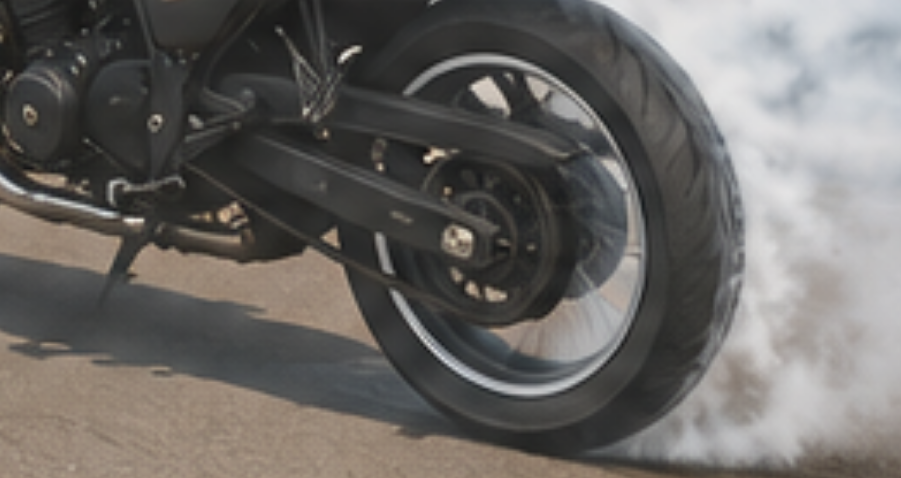
Applying too much rear brake can lock the wheel, particularly when braking transfers weight toward the front tire.
The rear tire then carries less load and can lose traction more easily.
Water, oil, gravel, sand, leaves, painted road markings, metal covers, frost, and mud can reduce grip.
Even moderate braking or acceleration may create a skid when the road surface changes unexpectedly.
Selecting a much lower gear at high speed can make the rear wheel slow too suddenly.
Smooth downshifting and correct engine-speed matching can help reduce this risk.
Strong throttle input can make the rear tire spin, especially on powerful motorcycles or slippery roads.
Incorrect tire pressure, worn tread, old rubber, contamination, brake faults, wheel misalignment, or suspension problems may reduce stability.
The correct response depends on whether the motorcycle is upright, turning, fitted with ABS, or already moving sideways.
As a general principle, riders should avoid sudden corrections. Keep the motorcycle as upright as conditions allow, look toward the intended path, and reduce destabilizing inputs smoothly.
Abrupt handlebar movement can turn a manageable skid into a larger loss of control.
The rider should maintain a stable body position and avoid staring at an obstacle or the road edge.
On an ABS-equipped motorcycle, firm brake pressure is generally maintained while the system modulates wheel pressure according to its design.
On a non-ABS motorcycle, the correct response can depend on how far the rear wheel has moved out of line.
An incorrect release or reapplication may cause the motorcycle to regain traction abruptly. Riders should learn skid-recovery techniques in an approved training environment.
A short pre-ride inspection can reveal several avoidable problems.
| Inspection Item | What to Check |
|---|---|
| Rear tire | Pressure, tread, cracks, objects and age |
| Rear brake | Pedal travel, fluid level and unusual drag |
| Wheel alignment | Correct adjustment and centered tracking |
| Chain or belt | Tension, condition and lubrication |
| Suspension | Leaks, loose parts and incorrect adjustment |
| Load | Secure position and balanced weight |
| Road surface | Water, gravel, oil and construction debris |
Heavy luggage placed too far rearward or to one side can affect steering and braking behavior.
The load should remain within the motorcycle manufacturer’s limits and be secured so that it cannot shift during acceleration, braking, or cornering.
A passenger should also understand how to sit, hold on, and move with the motorcycle.
Yes. Poorly fitted accessories may reduce tire, suspension, or brake clearance.
A Motorcycle rear fender, bracket, luggage component, or connecting plate should be checked throughout the suspension’s full range of movement.
Confirm that the tire cannot contact:
Fender inner surface
Mounting bolts
Wiring
License-plate bracket
Luggage supports
Brake hose
Exhaust components
Loose accessories
The inspection should consider suspension compression, passenger weight, luggage, and tire-size changes—not only the motorcycle standing unloaded.
We manufacture Motorcycle Fenders, connecting plates, docking hardware, luggage racks, backrests, exhaust products, fuel tanks, and carbon-fiber components.
For customized rear assemblies, buyers can provide drawings, mounting-hole positions, tire dimensions, suspension-clearance information, material requirements, and surface-finish references.
Sample installation checks can help verify that the component maintains suitable clearance and alignment before bulk production.
Developing rear fenders or related accessories for custom motorcycles and aftermarket distribution?
Send us the motorcycle model, wheel and tire size, mounting drawing, required clearances, material, finish, packaging, and quantity. We will review the requirements and prepare a Motorcycle Rear Fender proposal.


 Mobile Phone:
 Phone:
 Contact Now