Securing a motorcycle to a trailer requires more than pulling several straps tight.
The motorcycle must remain upright, resist forward and sideways movement, and avoid damage to its suspension, controls, bodywork, exhaust, or accessories.
Always confirm the trailer’s load rating, tie-down-point rating, ramp capacity, motorcycle weight, and local transport requirements before loading.
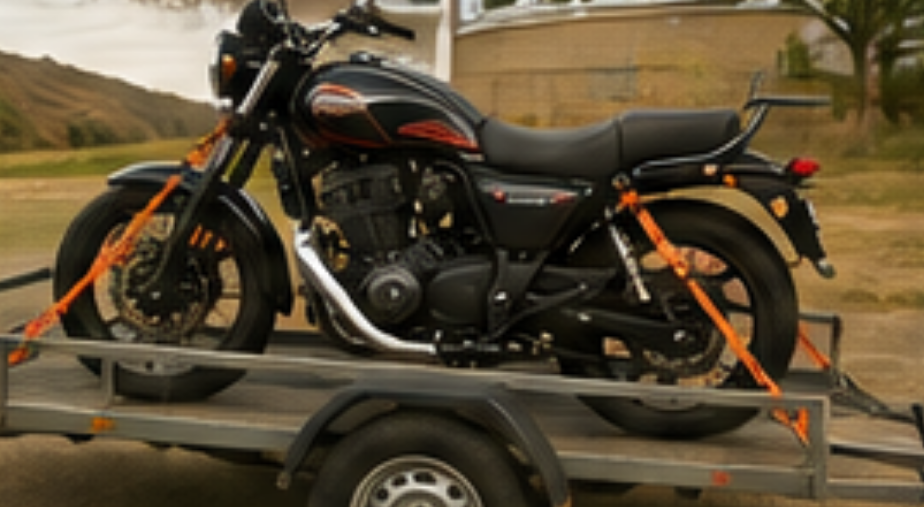
A typical setup may include:
Trailer rated for the motorcycle’s weight
Suitable loading ramp
Front-wheel chock
Ratchet straps or motorcycle tie-downs
Soft loops
Rear stabilizing straps
Wheel straps where required
Non-slip footwear
A second person to assist
Do not use worn straps, damaged hooks, knotted webbing, or unmarked equipment with unknown capacity.
Remove or secure loose items such as:
Detachable luggage
Tank bags
Tools
Covers
Phone mounts
Loose seat accessories
Unlocked side cases
Check that the handlebars, mirrors, exhaust, and body panels will clear the trailer structure.
A Motorcycle Luggage Rack is designed to carry an approved load during riding.
It should not automatically be treated as a structural trailer tie-down point. Unless the motorcycle or rack manufacturer specifically approves it, attach transport straps to stronger frame or chassis points.
Our luggage-rack and connecting-plate range includes stainless steel racks, docking hardware, brackets, and mounting plates produced for accessory installation.
Position the trailer on level ground and connect it securely to the tow vehicle.
Align the ramp with the wheel chock. Walk or power the motorcycle up only when the ramp surface, angle, width, and operator experience make the method safe.
A second person can stabilize the motorcycle from the opposite side.
Move the front tire fully into the wheel chock.
The chock helps position the motorcycle but should not normally be the only device holding it upright during transport.
Use points recommended by the motorcycle manufacturer.
Suitable locations may include accessible frame sections or robust lower triple-clamp areas, depending on the motorcycle.
Avoid attaching straps to brake lines, electrical wiring, plastic panels, mirrors, grips, and controls.
Soft loops can protect painted surfaces and prevent hooks from contacting the motorcycle directly.
Attach one strap to each side and lead them forward and outward to rated trailer anchors.
Tighten the straps alternately so the motorcycle remains vertical.
Compress the suspension only enough to keep the motorcycle stable and the hooks seated. Excessive compression can damage seals, suspension components, handlebars, or mounting parts.
Rear straps help control sideways movement and prevent the motorcycle from bouncing.
Use approved structural points near the passenger-footpeg brackets, frame, or another manufacturer-approved location.
The rear straps normally need less tension than the primary front straps.
Keep webbing away from:
Exhaust pipes
muffler edges
Brake discs
Chains and belts
Sharp brackets
Tire tread
Carbon-fiber edges
Moving suspension parts
Use protective sleeves where the strap could rub against a safe but abrasive surface.
Before driving, confirm that:
The motorcycle is vertical.
The front wheel is seated in the chock.
Hooks cannot fall free if the suspension moves.
Straps are not twisted.
No strap contacts a sharp or hot component.
The side stand is positioned according to the transport method.
Loose accessories have been removed or secured.
The trailer lights and coupling work correctly.
The total load remains within all weight ratings.
The motorcycle cannot roll forward or backward.
Stop after a short distance in a safe location and check every strap.
Webbing may settle, suspension may move, and hooks may change position during the first part of the journey.
Recheck the load at fuel stops and after driving over rough roads.
We manufacture luggage racks, connecting plates, four-point docking hardware, accessory installation kits, Motorcycle Backrests, and trunks with backrests.
Product development can include mounting geometry, stainless steel construction, hardware selection, load requirements, surface finish, and packaging.
Sample installation can be used to confirm alignment and mounting-point compatibility before bulk production.
Developing racks, docking systems, backrest supports, or connecting plates for a motorcycle accessory range?
Send us the motorcycle model, mounting dimensions, load requirement, material, finish, hardware list, packaging, and order volume. We will prepare a Motorcycle Luggage Rack proposal for sample evaluation.
Previous: How To Winterize A Motorcycle?


 Mobile Phone:
 Phone:
 Contact Now