A motorcycle muffler reduces the noise created when high-pressure exhaust gases leave the engine. It is installed near the end of the exhaust system and is also commonly called a silencer.
Its role is more complex than simply making the motorcycle quieter. The muffler influences exhaust tone, gas flow, heat direction, overall system weight, and the way the motorcycle responds after an exhaust modification.
A suitable Motorcycle Exhaust Muffler must therefore match the engine, connecting pipe, mounting points, intended sound, and regulations of the target market.
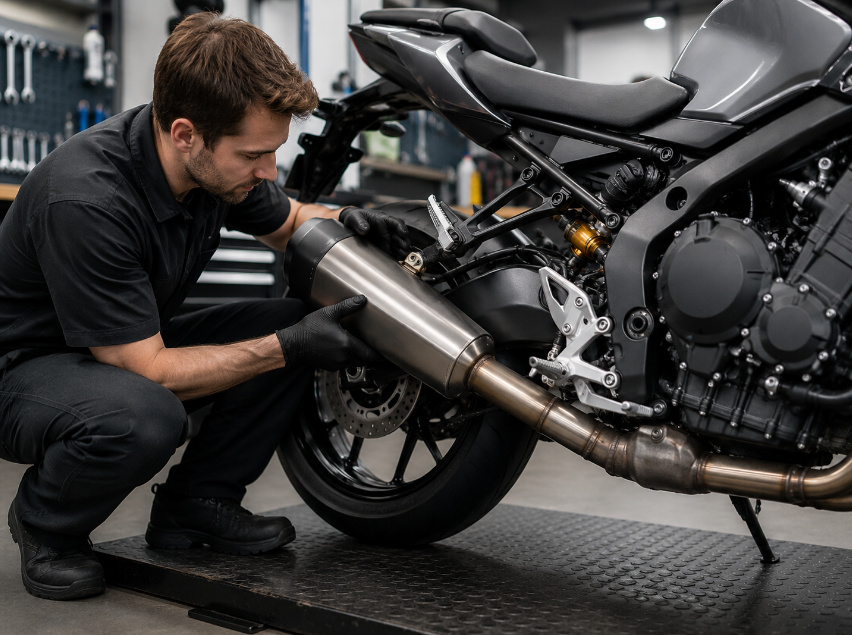
During combustion, the engine produces repeated high-pressure exhaust pulses. These pulses travel through the exhaust header and connecting pipe before leaving the motorcycle.
Without any sound-control structure, the pulses reach the atmosphere with very little attenuation and create an extremely sharp exhaust note.
The sound depends on several factors:
Engine displacement
Number of cylinders
Firing order
Engine speed
Header length
Pipe diameter
Muffler volume
Internal core structure
Sound-absorbing material
Outlet size
This is why two motorcycles fitted with visually similar mufflers may still sound very different.
The primary function of the muffler is to lower sound pressure before the exhaust gas reaches the outlet.
Different mufflers use different internal structures to manage sound.
An absorptive design commonly uses a perforated inner tube surrounded by heat-resistant packing material.
The exhaust gas moves through the central tube while part of the sound energy enters the surrounding material and is dissipated.
Straight-through absorptive structures are common in modified motorcycle exhaust systems because they can combine controlled flow with a sportier exhaust note.
A chambered muffler guides sound waves through several passages or cavities.
The changes in direction and internal volume help weaken selected sound frequencies before they leave the outlet.
This structure may produce a deeper and more controlled sound, although its design must be matched carefully to the engine and flow requirement.
Some mufflers combine perforated cores, chambers, baffles, resonating spaces, and packing materials.
The objective is to manage both overall volume and sound character without creating an unsuitable restriction.
A muffler does not only determine whether the motorcycle is loud or quiet. It also changes how the exhaust sounds.
The rider may hear differences in:
Low-frequency depth
High-frequency sharpness
Idle tone
Acceleration sound
Deceleration sound
Highway drone
Mechanical rasp
Sound at high engine speed
A longer muffler generally provides more internal space for acoustic control. A very short muffler often produces a louder and sharper note, although internal construction remains more important than external length alone.
Exhaust gas leaves the engine at a high temperature.
The muffler and outlet should direct this gas away from the rider, passenger, tire, brake hose, luggage, body panels, and electrical components.
Poor exhaust positioning can lead to:
Heat damage to nearby parts
Discoloration of bodywork
Passenger discomfort
Hot gas reaching luggage
Reduced clearance near the rear tire
Carbon deposits on surrounding surfaces
The outlet direction should be checked with the motorcycle both unloaded and carrying a passenger or luggage.
The muffler is only one part of the system.
A motorcycle exhaust may also include:
Exhaust header
Collector
Catalytic converter
Oxygen-sensor connection
Mid-pipe or link pipe
Muffler
Mounting bracket
Heat shield
Removable sound insert
Changing one component may affect the fitment and operation of the others.
For example, replacing only the muffler may require a compatible reducer, link pipe, clamp, bracket, or oxygen-sensor arrangement.
Every exhaust component creates some resistance to gas flow. However, an engine does not simply need as much back pressure as possible.
The more useful goal is controlled exhaust flow and appropriate pressure-wave behavior for the engine design.
An unsuitable muffler may create excessive restriction, while a very open system may change gas velocity, sound, and engine response. The correct balance depends on the motorcycle, engine speed range, header design, fuel system, and intended use.
After a major exhaust change, some motorcycles may require inspection of the air-fuel calibration or engine-management settings.
A DB killer is a removable or fixed insert placed near the muffler outlet.
It normally reduces the effective outlet area and changes the path of the exhaust gas, helping lower sound output.
The result depends on:
Insert length
Outlet diameter
Perforation pattern
Position inside the muffler
Engine displacement
Internal muffler structure
A DB killer should be designed for the specific muffler. An improvised insert may loosen, create abnormal restriction, or produce an undesirable whistle.
Inspect the muffler when the motorcycle develops:
A sudden increase in noise
Metallic rattling
Cracked welds
Loose mounting brackets
Burned or missing packing
Exhaust leakage around a clamp
Severe surface corrosion
Discoloration near a joint
Contact with the tire or swingarm
A loose muffler places additional stress on the link pipe and mounting points. Small problems should be corrected before vibration causes wider damage.
Common motorcycle muffler materials include stainless steel, titanium, aluminum, and carbon-fiber outer sleeves.
| Material | Main Consideration |
|---|---|
| Stainless steel | Strength, practical fabrication and corrosion resistance |
| Titanium | Lower weight and distinctive heat coloration |
| Aluminum | Lower weight but requires suitable heat management |
| Carbon-fiber sleeve | Low weight and decorative appearance |
| Mixed construction | Combines different materials for the shell, core and end caps |
The internal tube, welds, brackets, packing, and end-cap structure are as important as the outer shell material.
We manufacture motorcycle mufflers, headers, mid-pipes, link pipes, full exhaust systems, carbon-fiber mufflers, heat shields, and related modified motorcycle components.
Our factory operates two exhaust production lines with a stated monthly capacity of more than 20,000 exhaust sets. We also use dedicated laboratory equipment to support product inspection and development.
For customized projects, buyers can provide:
Motorcycle model and year
Engine displacement
Pipe diameter
Muffler length
Mounting position
Material
Surface finish
Required sound character
DB killer structure
Packaging requirements
Planning mufflers for motorcycle manufacturers, aftermarket brands, distributors, or modification workshops?
Send us the motorcycle application, installation dimensions, pipe connection, mounting drawing, material, sound requirement, target market, packaging, and order quantity. We will prepare a motorcycle exhaust muffler proposal for technical review and sample evaluation.


 Mobile Phone:
 Phone:
 Contact Now