There is no single Motorcycle Exhaust that sounds best on every bike. Exhaust sound is subjective, and the same muffler can produce a deep pulse on one engine but sound sharp or hollow on another.
The best result is usually an exhaust that complements the motorcycle’s natural firing character, remains comfortable during longer rides, avoids excessive noise, and meets the regulations of the intended market.
A good exhaust note is not simply the loudest one.
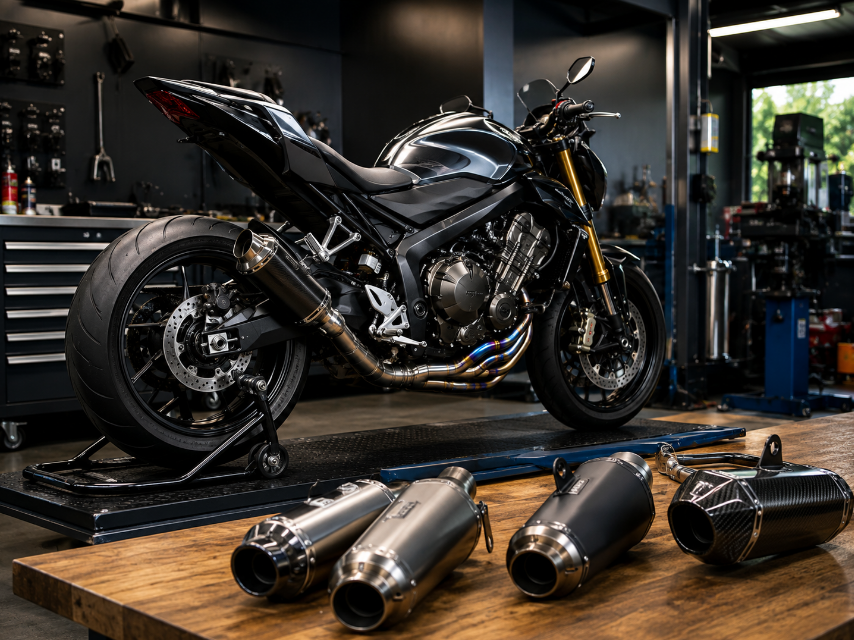
Riders often describe a desirable exhaust using words such as:
Deep
Smooth
Crisp
Full
Controlled
Aggressive
Refined
Mechanical
Low-pitched
Race-inspired
These descriptions refer to several different sound qualities.
Pitch describes whether the exhaust sounds low and deep or high and sharp.
Engine configuration has a major influence on pitch, but pipe length, muffler volume, and outlet size also affect the final result.
Volume is the overall loudness of the exhaust.
A louder system may sound exciting during short acceleration, but it can become uncomfortable during highway riding or create problems in residential areas.
Tone describes the character of the sound rather than its loudness.
Two mufflers can produce a similar sound level while one sounds smooth and the other sounds metallic or harsh.
Drone is a repeated low-frequency sound that becomes tiring at a steady engine speed.
A muffler that sounds good during acceleration may still create unpleasant drone during normal cruising. This is why sound testing should include more than idle and short throttle demonstrations.
The exhaust cannot completely change the basic character created by the engine.
Single-cylinder motorcycles usually produce widely spaced exhaust pulses.
A suitable muffler can create a strong, clear beat, but an excessively open system may sound sharp and uncontrolled.
Parallel twins can produce very different tones depending on the crankshaft arrangement and firing interval.
Some sound even and smooth, while others produce a more irregular, V-twin-like rhythm.
V-twin motorcycles are often associated with a deeper pulse and a strong low-frequency character.
Pipe length, collector design, and muffler volume determine whether the final result sounds full or excessively boomy.
Three-cylinder motorcycles often combine a deeper lower range with a distinctive higher-frequency note as engine speed increases.
A muffler that controls rasp without removing the engine character can produce a balanced result.
Inline-four motorcycles commonly develop a smoother and higher-pitched exhaust note at high engine speed.
A very short muffler may make the sound harsh, while a longer body can add more control.
Longer mufflers generally provide more internal volume for sound absorption and frequency control.
Shorter mufflers tend to produce a more immediate and aggressive sound, but may also increase harshness and overall volume.
A larger core can reduce flow restriction, but it can also increase noise when the rest of the design remains unchanged.
A smaller core may control sound more strongly but must not create unsuitable restriction for the engine.
Sound-absorbing packing helps reduce higher-frequency noise.
The density, heat resistance, amount, and installation of the material all affect the result. Packing can deteriorate after long-term heat exposure, causing the muffler to become louder.
Round, oval, slash-cut, dual-outlet, and tapered end caps can change the appearance and slightly influence the sound at the outlet.
The internal outlet diameter usually has a greater effect than the decorative external shape.
| Muffler Type | Typical Sound Character | Main Consideration |
|---|---|---|
| Straight-through | Open, sporty and direct | Packing condition affects sound over time |
| Chambered | Deeper and more controlled | Internal design can increase restriction |
| Short-body muffler | Sharp and aggressive | Greater risk of excessive loudness |
| Long-body muffler | Fuller and smoother | Requires more installation space |
| Muffler with DB killer | Adjustable or reduced volume | Insert must match the muffler design |
These are general tendencies rather than guaranteed outcomes.
Material can influence resonance, wall vibration, weight, and heat behavior, but it is not the only factor.
A carbon-fiber outer sleeve may produce a different resonance from a thin metal shell, while titanium and stainless steel can develop different tonal qualities depending on thickness and internal construction.
The sound is determined by the complete assembly:
Inner core
Outer shell
Packing
End caps
Welded joints
Muffler volume
Link pipe
Header system
Selecting a material only because it is expected to sound deeper can lead to disappointment.
Online recordings are useful for initial research but do not reproduce the sound perfectly.
Microphone position, recording equipment, compression, room reflections, wind, and speaker quality can change what the listener hears.
A practical comparison should include:
Cold start
Warm idle
Gentle acceleration
Strong acceleration
Steady cruising speed
Deceleration
Sound with and without the DB killer
Sound from the rider’s position
Sound behind the motorcycle
The system should also be checked for vibration and unwanted metallic rattling.
A very loud exhaust can hide poor tonal quality.
Excessive volume may also:
Cause rider fatigue
Disturb nearby residents
Make passenger communication difficult
Attract enforcement attention
Prevent the motorcycle from passing inspection
Limit where the motorcycle can be used
Mask unusual engine or mechanical sounds
The better objective is a clear and recognizable tone at a reasonable sound level.
Motorcycle noise and exhaust rules vary by country, state, and city.
Some markets regulate maximum noise levels, prohibit bypass devices, or require the exhaust to carry an approval or compliance label.
A muffler intended for track use may not be permitted on public roads.
Buyers should confirm the legal requirements before approving the core diameter, DB killer, catalyst arrangement, and sound target.
An exhaust that sounds attractive still needs to fit the motorcycle correctly.
Confirm:
Inlet diameter
Link-pipe angle
Bracket location
Rear tire clearance
Passenger-footrest clearance
Luggage clearance
Ground clearance
Oxygen-sensor position
Heat-shield requirement
Fitment problems can lead to leaks, vibration, heat damage, or stress on the exhaust joints.
Our product range includes universal mufflers, model-oriented exhaust systems, stainless steel mid-pipes, headers, carbon-fiber mufflers, heat shields, and mufflers supplied with removable DB killers.
For a Custom Motorcycle Exhaust Muffler, sound development can involve changes to:
Muffler length
Body shape
Core diameter
Packing structure
Outlet design
DB killer
Link-pipe dimensions
Mounting bracket
Shell material
Surface finish
Our laboratory and production teams support sample inspection before larger orders are confirmed.
Send us the motorcycle model, engine displacement, original pipe dimensions, preferred sound direction, sound-control requirement, muffler material, finish, mounting details, target market, and quantity.
We will prepare a Custom motorcycle exhaust muffler proposal that balances sound, installation, appearance, and production consistency.


 Mobile Phone:
 Phone:
 Contact Now