For a road-going motorcycle, the practical answer is generally yes. A muffler helps control exhaust noise, directs hot gas away from the rider and motorcycle, and forms part of the exhaust system developed for the engine.
A motorcycle engine may physically run with an open or very short exhaust pipe, but that does not mean the configuration is safe, suitable, legal, or correctly tuned for normal road use.
Requirements vary between markets, so the original exhaust should not be removed without checking local laws and the motorcycle manufacturer’s instructions.
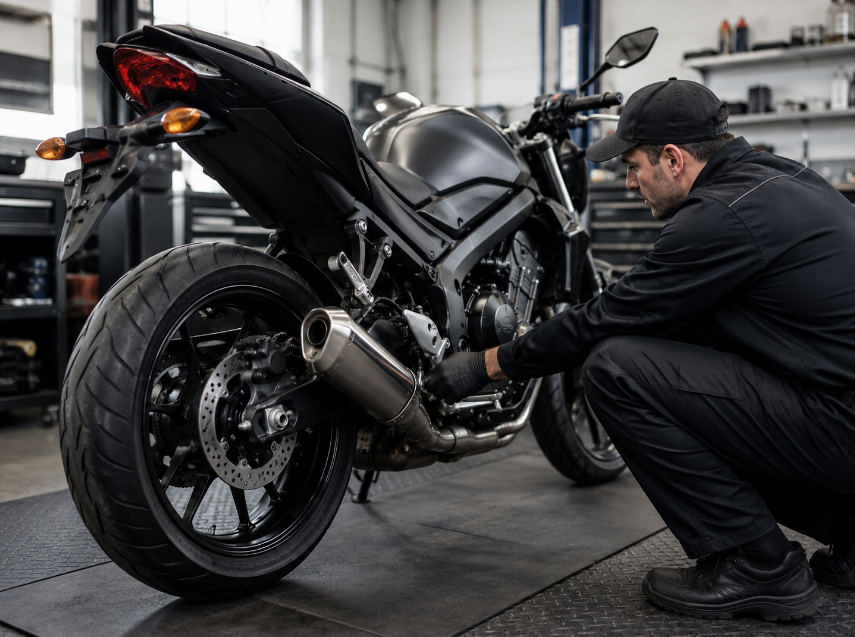
Internal-combustion engines release exhaust gas in high-pressure pulses.
The muffler reduces the sound energy generated by those pulses before they reach the atmosphere.
It also provides a controlled outlet position so hot gas and noise are directed toward a suitable area behind or beside the motorcycle.
Without a muffler, the exhaust is likely to be much louder and less comfortable for the rider, passenger, and people nearby.
Road laws differ by location, but many jurisdictions require registered internal-combustion vehicles to use an adequate and properly maintained muffler.
Rules may also prohibit:
Muffler bypasses
Exhaust cutouts
Gutted mufflers
Noise-amplifying devices
Systems exceeding permitted sound levels
Removal of required emission components
A competition-only exhaust may be acceptable at an approved closed-course event but unsuitable for public-road use.
Before changing the exhaust, verify the rules in the country, state, province, or city where the motorcycle will be used.
The most immediate difference is a large increase in sound.
The noise may include sharp combustion pulses, metallic resonance, popping, and an uncomfortable high-frequency edge.
The result is not always a deeper or better sound. An open pipe can make the engine sound uncontrolled and may create strong drone at certain engine speeds.
Removing the muffler changes the total exhaust length, outlet size, flow resistance, and pressure-wave behavior.
Depending on the motorcycle, this may affect:
Low-speed response
Mid-range torque
Throttle behavior
Deceleration popping
Air-fuel readings
Engine-management correction
Fuel consumption
A less restrictive system does not automatically produce more usable power.
The original muffler normally positions the outlet away from sensitive parts.
Removing it may leave the exhaust ending near:
Rider’s foot
Passenger footrest
Rear tire
Brake line
Swingarm
Luggage
Bodywork
Electrical wiring
The remaining pipe should never discharge directly toward a person or heat-sensitive component.
The muffler and bracket can provide support for the end of the exhaust system.
Removing the unit may leave the mid-pipe unsupported, allowing vibration to concentrate around welded joints and clamps.
A temporary open-pipe configuration can therefore lead to cracking or loosening elsewhere in the system.
No. Muffler requirements change according to the engine and exhaust layout.
Common systems include:
Single muffler
Dual mufflers
Two-into-one exhaust
Four-into-one exhaust
Under-seat muffler
Low-mounted muffler
High-mounted dirt-bike silencer
Integrated catalytic muffler
Separate catalyst and muffler
The replacement should match the original inlet diameter, mounting position, pipe routing, and sensor arrangement.
The muffler and catalytic converter have different primary functions.
The muffler controls exhaust noise. The catalytic converter helps reduce selected exhaust pollutants through chemical reactions.
On some motorcycles they are separate components. On others, the catalyst may be integrated into the header, collector, or muffler assembly.
Removing a muffler must not result in the unauthorized removal of a required catalytic converter or emission-control device.
Off-road and competition motorcycles may use lighter or more open silencers, but they still commonly require sound control.
Riding areas, race organizers, parks, and local authorities may impose sound limits. Some off-road environments also require a spark arrestor.
The correct product should match the specific riding location rather than being described simply as a “race exhaust.”
Some muffler problems can be repaired.
Possible service work includes:
Replacing packing material
Tightening clamps
Replacing a bracket
Repairing a minor weld crack
Replacing rivets
Installing a new DB killer
Replacing an end cap
Correcting a leaking joint
Replacement is more appropriate when the shell is severely damaged, the internal core is broken, mounting points have failed repeatedly, or corrosion has weakened the structure.
Before purchasing, record the motorcycle details and measure the existing system.
| Specification | What to Confirm |
|---|---|
| Motorcycle application | Model, year and engine size |
| Inlet diameter | Connection to the link pipe |
| Muffler length | Available installation space |
| Bracket position | Distance and angle to mounting point |
| Outlet direction | Clearance from rider and bodywork |
| Material | Stainless steel, titanium or carbon-fiber structure |
| Sound control | Fixed baffle or removable DB killer |
| Road approval | Requirements of the target market |
| Packaging | Protection for shell and end caps |
A universal muffler may still require a model-specific link pipe and bracket.
After installing the muffler:
Confirm that every clamp is secure.
Check that the muffler does not contact the swingarm or tire.
Verify passenger and luggage clearance.
Start the engine and inspect for exhaust leaks.
Listen for metallic vibration.
Check the bracket after a short ride.
Inspect for unusual heat marks.
Review engine operation and warning lights.
Allow the system to cool before touching or adjusting it.
We manufacture universal and model-oriented exhaust mufflers, headers, link pipes, mid-pipes, carbon-fiber exhaust products, full systems, DB killers, and heat shields.
Our company was established in 2004 and specializes in modified motorcycle exhausts, fuel tanks, fenders, and carbon-fiber components. The factory has dedicated exhaust production lines and testing equipment for product-development and quality-control requirements.
OEM and ODM projects can cover:
Muffler dimensions
Pipe connection
Mounting brackets
Internal core
DB killer
Material
Surface finish
Laser logo
Accessories
Retail or transport packaging
Sourcing silencers for motorcycle assembly, aftermarket distribution, private-label retail, or workshop installation?
Send us the motorcycle application, original exhaust dimensions, sound target, legal-market requirements, material, finish, accessory list, packaging, and order volume. We will prepare a Motorcycle Exhaust Silencer proposal for sample confirmation.


 Mobile Phone:
 Phone:
 Contact Now